The Company No One Insisted on Doing an Audit - The Theranos Lesson
Theranos raised more than $700 million before it ever produced financial statements an independent auditor had checked. The lesson isn't about one founder's dishonesty - it's about who has the standing, and the will, to ask.
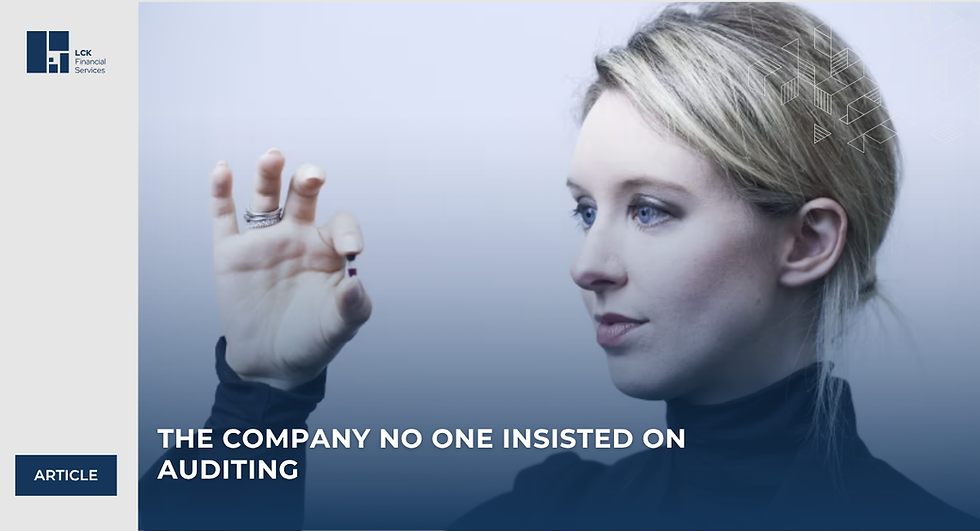
By the time Theranos had raised over seven hundred million dollars, its investors had seen a great deal. They had seen demonstrations of the company's blood-testing device. They had seen patents, partnership announcements, and magazine profiles that treated its founder as the natural heir to Steve Jobs. They had seen a board stacked with two former US secretaries of state, a former senator, and a retired admiral.
What they had not seen, almost without exception, was a set of financial statements checked by anyone independent of the company. Not a balance sheet. Not a cash-flow statement. Not an income statement carrying a signature belonging to anyone other than Theranos itself. It would take until 2017 - after most of the money had already been raised and spent - for the company to produce its first audited accounts. And it did so only because a lender made it a condition of a loan.
Most retellings of Theranos treat it as a story about one person's dishonesty. It is more useful, and considerably less comfortable, read as a story about an absence: the absence of anyone with the standing, or the inclination, to ask a formal, independent question of the numbers. That absence isn't unique to Theranos, and it isn't really a story about blood-testing technology at all. It is a story about what happens, structurally, when a private company grows large enough to matter before anyone with real leverage insists on checking its arithmetic.
What does it actually mean when a company’s numbers go through an audit?
It's a phrase used loosely enough in everyday business conversation that it's worth being precise about, particularly because the precision is exactly what Theranos's investors lacked.
IN PLAIN TERMS An independent audit is a review of a company's financial statements by a qualified accounting firm with no financial stake in the outcome, testing whether the figures presented are complete, accurate, and prepared in line with recognised accounting standards. It is not a guarantee that a business will succeed. It is a guarantee that when a company states its cash position or its revenue, someone outside the building has independently checked it. |
That distinction - between a company's own account of itself and an independent verification of that account - is the whole of what follows.
Why did nobody require Theranos to audit and prove its numbers?
Theranos was a private company throughout its life, and private companies, unlike listed ones, carry no general legal obligation to produce audited financial statements or to maintain an independent audit committee. In practice, the market usually supplies its own discipline in place of that legal requirement: once a private company is raising tens or hundreds of millions of dollars, sophisticated investors typically insist on audited numbers as a condition of writing large cheques, precisely because no regulator is checking the figures on their behalf.
Theranos didn't attract that kind of pressure in the way a venture-backed technology company usually would. Much of its capital came from wealthy individuals and family investment vehicles rather than institutional funds with in-house diligence teams built for exactly this purpose. For most of the company's life, its board had no audit committee, and directors with deep public-service credentials were not, in the main, the investors with capital directly at risk. And the company's own narrative - genuinely novel technology, secrecy justified as protecting trade secrets from larger rivals - gave everyone around the table a ready-made reason not to press the point.
The pattern repeated outside the boardroom, too. Theranos's commercial partnerships with Walgreens and Safeway - arrangements that ultimately committed hundreds of millions of dollars between them - went ahead without either retailer independently verifying the underlying technology or demanding audited financials as a condition of the relationship. Two large, experienced public companies extended trust on the strength of a story and a demonstration, in much the same way individual investors did. The absence of scrutiny wasn't confined to any one room; it was the default setting almost everywhere the company operated.
What happened when someone finally did ask?
The turning point came in 2017, not from a shareholder but from a creditor. A loan agreement with Fortress Investment Group required Theranos to produce audited financial statements for that year, prepared under US GAAP, as a condition of the facility. The company engaged OUM & Co LLP, and the resulting opinion - delivered to management and the board - was the first genuinely independent check performed on the company's numbers in its history. It reportedly raised doubts about the company's ability to continue as a going concern.
The mechanism worked exactly as intended. It simply arrived years later than it should have, and only because a party with contractual leverage - rather than an investor relying on goodwill - had the standing to insist on it.
What followed makes the cost of that delay concrete. Within a year of the audited statements being produced, regulators had filed fraud charges against the company's founders; the business wound down entirely by September 2018. A criminal trial followed, ending in convictions in 2022 and prison sentences in 2023. None of that outcome required the technology to have worked as claimed. It required, at minimum, someone with real standing to have asked the ordinary question years earlier - while it was still a matter of correcting course, rather than unwinding a decade of claims made on the back of numbers nobody outside the company had ever checked.
When does a business actually need independent assurance - and when is it overkill?
Not every company at every stage needs the same level of scrutiny, and treating an early-stage business as if it were preparing for public markets is its own kind of waste - a seed-stage founder spending materially on an independent audit before there's much to audit is solving a problem that doesn't yet exist. The distinction that matters is less about company size than about who is relying on the numbers, how far removed they are from the business day to day, and how much is riding on those numbers being right.
LOW RISK - SELF-REPORTED IS FINE An early-stage friends-and-family or seed round Cheque sizes small enough that investors can absorb a full loss Investors close enough to the business to see it directly, not relying on reported figures alone | INDEPENDENT ASSURANCE MATTERS A raise from parties who are not in the business day to day Revenue, growth, or cash figures material to the valuation being claimed Any pending transaction - acquisition, large loan, pre-IPO - where a counterparty will rely on the numbers |
Theranos sat unmistakably in the second column for years while operating as though it belonged in the first.
What does independent assurance actually cost, against what it protects?
An independent audit or review is a real cost for a growth-stage private company - professional fees, management time, and the ongoing discipline of keeping clean books throughout the year rather than assembling them under pressure ahead of a raise. That cost is genuine, and it is fair for founders to weigh it, particularly against the fundraising and product costs already competing for the same budget.
Set against it is what independent assurance actually protects: the credibility of every figure a company puts in front of an investor, a lender, or a potential acquirer, and - as Theranos shows in the starkest terms available - the ability to catch a developing problem in year one, while it is still a correction, rather than in year fourteen, when it has become a collapse. Measured against the sums typically being raised or transacted at the point independent assurance becomes relevant, the cost of the check is consistently small next to the cost of being wrong about the numbers it verifies.
What should a founder or board put in place before it's asked for?
A handful of practices would have changed the Theranos story substantially, and none of them require a company to be public, or even large, to adopt:
Establish an audit committee, or an equivalent oversight function, with direct and unfiltered access to the company's auditors - independent of management, well before it becomes a legal requirement.
Commission independent financial statements ahead of a large raise or transaction, not in response to one being demanded by a lender or a lawyer.
Treat a request for audited numbers, from any counterparty, as ordinary due diligence rather than an implication of distrust - the companies with nothing to hide are, in practice, the ones least inconvenienced by the question.
For scale-ups, family offices, and international groups operating across borders, financial reporting and assurance isn't a compliance cost bolted onto a growth story after the fact. It's the mechanism that allows a growth story to be believed by anyone who isn't already in the room - a board member, a bank, an acquirer, a co-investor thousands of miles away who will never see the office in person. The more a company's stakeholders are dispersed across jurisdictions and time zones, the more that independent check does the work that proximity and personal trust would otherwise have to do - and the less realistic it becomes to assume someone else, closer to the business, is already asking the question.
The question worth asking
Nobody ever needed permission to audit Theranos. No rule stopped an accountant from checking its books, no law barred an investor from demanding a balance sheet before writing a cheque, and no regulation prevented Walgreens or Safeway from requiring independent verification before committing to a partnership. What the company's history actually shows is simpler, and less flattering to everyone involved: for years, across boardroom, cap table, and commercial partners alike, nobody with the standing to ask - bothered to.
That is the more useful question to carry forward, applied to any fast-growing company, including one's own. Not whether its numbers could, in principle, be audited. Whether anyone has actually insisted that they are.



Comments